How much to bet
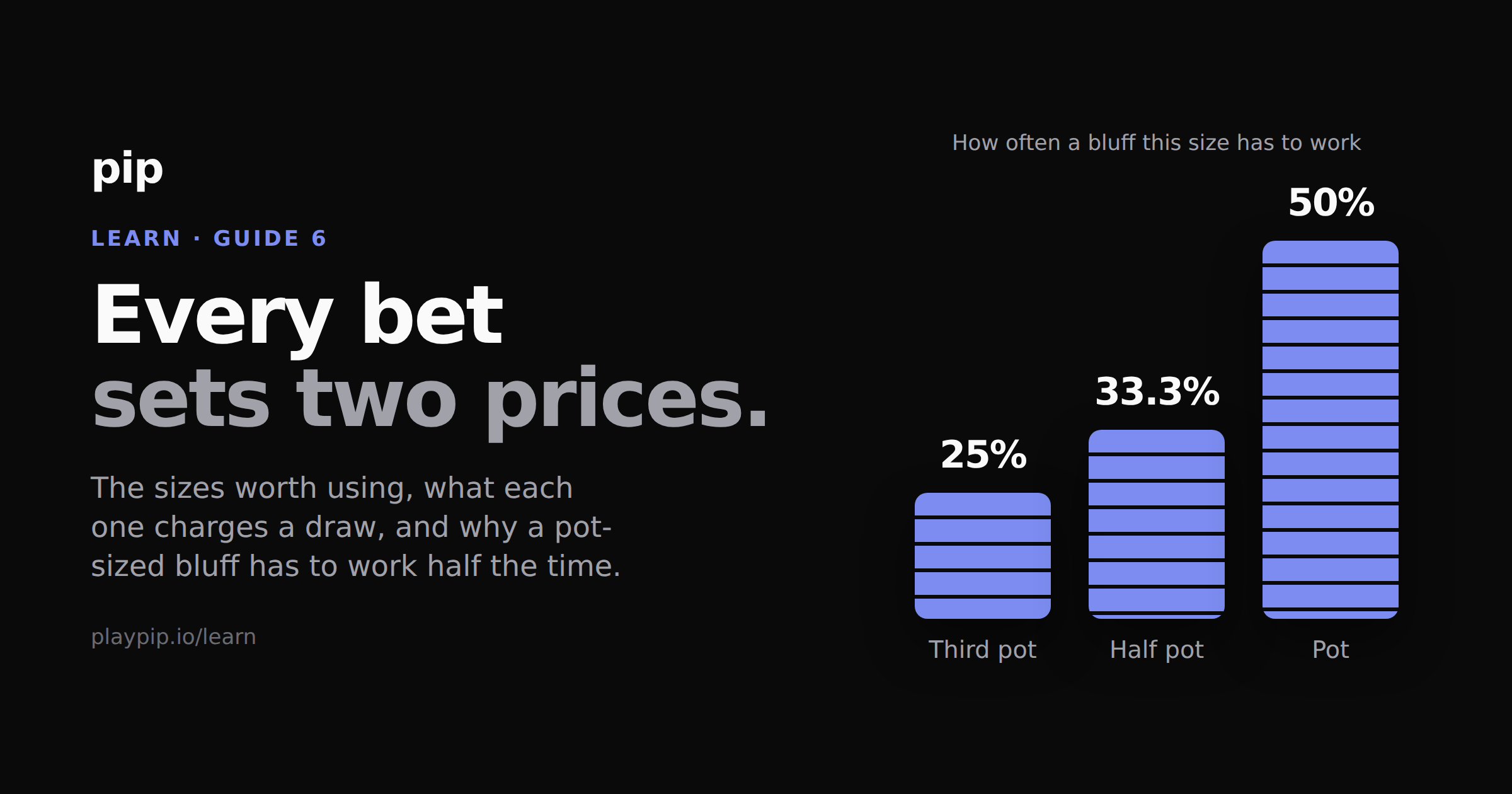
Most bets are worth between a third of the pot and the whole pot, and the size you pick inside that range should follow from what you want to happen next. A bet is not a measure of how much you like your hand. It is a price, and it sets two of them at once: the price the other player pays to continue, and the price you pay to find out.
Everything below is those two numbers.
The two prices in every bet
The price you give them. They call your bet to win the pot plus your bet, so the bigger you bet, the more often they need to be right. This is pot odds seen from the other side of the table.
The price you pay. You are risking your bet to win the pot as it stands, so the bigger you bet, the more often they have to fold for a bluff to break even.
| Your bet | They need to win | Your bluff needs folds |
|---|---|---|
| Third pot | 20% | 25% |
| Half pot | 25% | 33.3% |
| Two-thirds pot | 28.6% | 40% |
| Pot | 33.3% | 50% |
| Twice the pot | 40% | 66.7% |
Both columns climb together, and the trade is who each one costs. Betting more charges them more and puts you further out on a limb. A pot-sized bluff has to work half the time. A third-pot bluff has to work a quarter of the time, which is a much easier thing to be right about, and it is why small bluffs are usually better bluffs.
The fold column is break-even and ignores the times you get called and win anyway, so treat it as the worst case rather than the whole story. It is still the number that should stop you betting twice the pot with nothing.
The two prices
Pot 100Pick a size. Both figures are what that size costs, one to them and one to you.
You bet 50 into 100.
They need to win
25%
to call and break even
They must fold
33.3%
for a bluff to break even
The default. If you have not got a reason for another number, use this one.
Sizing when you have the best hand
You are betting to be called. So the size to pick is the largest one a worse hand can talk itself into calling, and that is a fact about their hand, not yours.
The most expensive habit in poker is betting so big that only better hands continue. You win the pot you already had and lose a big one when you are beaten. If you have top pair and you bet twice the pot, everything worse folds and everything better calls, and you have arranged to be right about nothing.
Small bets are how thin value gets paid. With a hand that is probably best but not much better than best, a third of the pot gets called by second pair. Two-thirds does not.
Sizing when they are drawing
This is the part with real arithmetic in it, and it is not what most people expect.
| Their draw | Their chance on the next card | The smallest bet that makes calling wrong |
|---|---|---|
| Gutshot, 4 outs | 8.5% | a tenth of the pot, 0.1x |
| Open-ended, 8 outs | 17% | a quarter of the pot, 0.26x |
| Flush draw, 9 outs | 19.1% | a third of the pot, 0.31x |
| Flush and open-ended, 15 outs | 31.9% | nearly the whole pot, 0.88x |
A third of the pot already makes a bare flush draw a losing call for one card. You do not need to bet the pot to charge a draw, and against fifteen outs you almost cannot, which is worth knowing before you decide the answer to a scary board is always a bigger bet.
Two honest caveats and neither is small.
You cannot really price anyone out, because implied odds are the money they win on the streets after they hit. What a bet does is make the call bad on its own terms, and how bad it needs to be depends on how much money is behind.
Bigger bets do charge draws more even after the call. Pricing them out is not the only goal. If they call a two-thirds bet with a flush draw, you have made a losing call happen, which is the second best outcome and often the likelier one.
What it takes to charge them
Pot 100Pick the draw they have. The bar is the smallest bet that makes calling it wrong.
They have
The flop
- They get there on the next card
- 19.1%
- The bet that makes calling wrong
- 0.31x the pot
The bar is the pot. The fill is the bet.
Bet 31 into 100 and calling with 9 outs stops paying for one card. Anything smaller and they are right to call, which is not the same as saying you should bet bigger: what you charge them after the call still counts, and so do the streets after they hit.
What the size does to the pot three streets later
The pot grows by one plus twice your bet every time a bet gets called, and it compounds.
| Bet size, every street | Pot multiplies by | Over three streets | A pot of 10 becomes |
|---|---|---|---|
| Third pot | 1.67x | 4.6x | 46 |
| Half pot | 2x | 8x | 80 |
| Two-thirds pot | 2.33x | 12.7x | 127 |
| Pot | 3x | 27x | 270 |
Your flop bet decides how big the river is. A small bet on the flop is not the cautious option, it is a decision to play a small pot on the river, and if you have the best hand that is a decision to win less. A pot-sized bet on the flop is a commitment to a pot 27 times the size of the one you started with, whether or not you still like your hand by then.
Nobody thinks about the river when they choose a flop size. That is the reason to.
The four sizes worth having
You need fewer sizes than you think. Four covers almost everything.
A third of the pot. Cheap, gets called wide, does its work on dry boards where nothing much can be drawing. The best bluff size, because it only has to work a quarter of the time.
Half the pot. The default. If you have not got a reason for another number, this is the number.
Two-thirds to three-quarters. For wet boards and for hands that want to charge a draw. This is where most value bets belong.
The pot. Rare. Reserve it for the times you are either very strong or completely giving up, and know that as a bluff it now has to work half the time.
And one to avoid. The min-bet asks the other player to be right one time in 12. Everybody is right one time in 12. A tenth-pot bet folds out nothing, charges nothing, and hands a free card its correct price. If a hand is worth betting it is worth a third of the pot, and if it is not, check.
The tell you are giving away for free
If you bet big with strong hands and small with weak ones, you have told the table what you have before they look at your cards. It is the most common leak in low-stakes poker and it does not need a read to exploit, only attention.
The fix is not complicated. Pick your size from the board and the situation, not from how much you like your hand. The same board should get the same size from you whether you have flopped a set or nothing at all. That is also what makes bluffs work, since a bluff is only ever believed because it looks exactly like the times you were not bluffing. Where you are sitting decides how often you get to make that choice at all, which is the position guide.
Sizing is a habit, and habits come from repetition rather than from tables.
You can play Texas Hold’em on Pip right now, in the browser. No account needed, nothing to install, no money involved anywhere and none to spend. The action bar has ½, ¾ and Pot buttons and a slider for everything else, which is most of what this page is about. The opponents decide by comparing what they think they are worth against the price you have just set them, so a bet that gives a draw a good price gets called by that draw, and you can watch it happen.